
➣ Hungarian: A Roma Program pályázati felhívása mostantól elérhető
➣ Polish: Trwa nabór wniosków w Programie Romskim na działania
➣ Romanian: Apelul de cereri de finanțare în Programul pentru romi este deschis acum
➣ Romanes: E Romane Programesko aplikaciako akharipe
➣ Slovak: Výzva na predkladanie žiadostí v rámci Rómskeho programu je otvorená
About Dalan Fund
For a couple of decades, the Central and Eastern Europe, the Caucasus, and Central and North Asia (CEECCNA) regions have been experiencing rapidly rising authoritarianism, militarization, anti-gender, and anti-democracy movements. Currently, there are ongoing wars, frozen conflicts, unsettled border disputes, authoritarian regimes, and rapid democratic backsliding.
Dalan Fund (DF) aims to transform how Central and Eastern Europe, the Caucasus, and Central and North Asia are resourced, fostering resilience and the collective power of intersectional social justice organizers and movements in and for the regions. As an activist-led, multi-regional, and participatory fund, DF was seeded in 2023 in response to multi-layered accumulated crises, acute shifts in the contexts, and threats to the resilience of activists and communities they support.
Recognizing that social justice movements and activists are at the forefront of driving transformative change across the regions, they need the resources to resist, recover, and sustain their work and create conditions for dreaming and envisioning futures beyond crises. The Fund is piloting its first thematic resource distribution cycle to support the work of Romani organising in four countries.
About the Romani Program: First Call for Proposals
In 2025, Dalan Fund launches the Romani Program, designed as a complementary mechanism to existing models of resource distribution for intersectional Romani organizing in Hungary, Poland, Romania, and Slovakia. Grounded in the lived experiences of Romani women, as well as trans, intersex, and gender-diverse people, the program aims to foster resilience, collective power, dignity, and access to human rights.
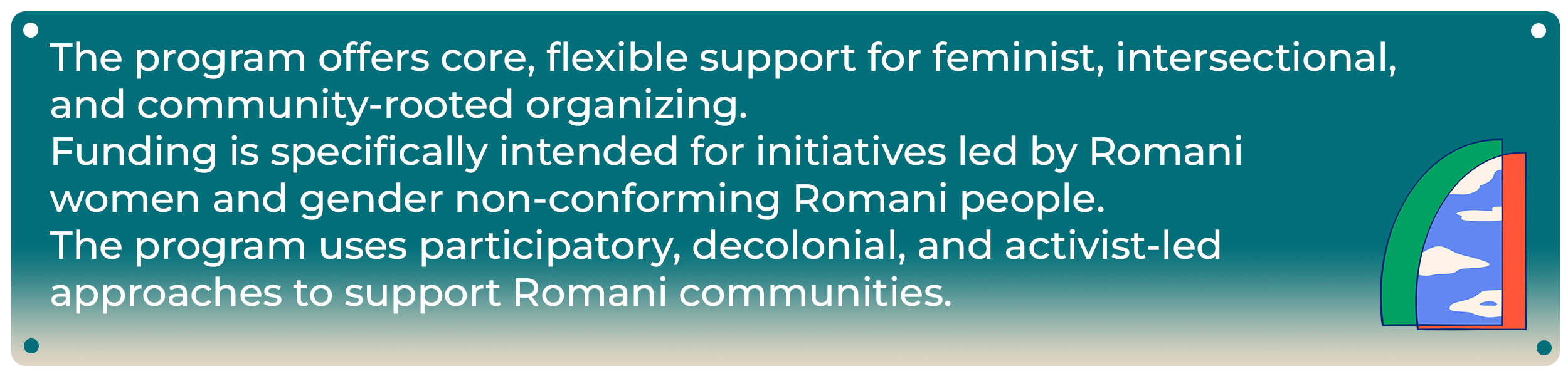
The strategic direction of the Romani Program has been shaped in close collaboration with our Romani Resource Distribution Committee (RDC), consisting of five Romani activist women, and through consultations with community members across the respective countries. Together, the Committee identified a shared political analysis of the key challenges and core elements of Romani intersectional organizing today:
- Segregation in education and housing, systemic racism, violence and anti-Gypsyism, and persistent processes of socioeconomic marginalization continue to shape the daily realities of Romani communities, limiting access to rights, resources, and dignity.
- Funding remains unequal and politicized, favoring top-down, non-Roma-led, project-based approaches. Donor agendas often fragment or reduce complex marginalization, and Roma expertise is largely excluded from EU-level programs.
- Romani civil society is shaped by competing interests, tokenism, and generational, social, and geographical (urban–rural) divides. Tensions may arise between traditional perspectives and emerging forms of activism, particularly those led by younger Romani women. In some cases, NGO language and approaches feel disconnected from local realities, limiting broader engagement and weakening collective strength.
- Romani women and LGBTQI+ communities are highly disadvantaged by patriarchal norms, gender-based violence, while feminist and intersectional frameworks of organizing remain inaccessible and underfunded.
- Radical religious and far-right actors promote anti-gender narratives and patriarchal values, reinforcing stereotypes and shaping Romani political participation and organizing through fear-based messaging.
- Roma-led efforts to narrative change – through theatre, storytelling, artivism, or community media – are under-supported and undervalued. The movement suffers from a lack of spaces for imagination, reflection, and creative strategy-making.
The advisory community imagines a strong Romani movement built on existing community assets, including local mutual aid networks and the leadership of young Romani women advancing feminist and intersectional approaches. There is a need to move beyond short-term, project-based funding cycles and instead invest in long-term, creative, and community-led organizing rooted in the lived experiences, knowledge, and collective power of Romani communities. Narrative change grounded in Romani agency, dignity, and self-representation is a strategic priority. Guided by this analysis, we are committed to supporting the ideas, strategies, and efforts emerging directly from Romani movements that align with this shared vision.
What do we mean when we say…
❖ Core flexible funding – Unrestricted funding that can be used to support the organization/group´s ongoing work, general operations, functioning, and priorities, even if they might change along the way. There is no need to invent a new project to apply for this funding – it is meant to be for the organisation as a whole and can be spent on anything that the organization already does.
❖ Fiscal Host – A fiscal sponsor is a registered nonprofit organization that allows smaller organizations or unregistered groups to use its legal status and bank account to receive grants. This relationship can be formalized through a Memorandum of Understanding or a contract. There are different models of fiscal sponsorship. In some cases, the sponsor may be actively involved in financial oversight, grant management, and reporting. In others, the sponsor simply receives funds and transfers them to the unregistered group. For this grant, if you are an unregistered group seeking to receive Dalan Fund’s support through a fiscal sponsor, please select a trusted fiscal sponsor that works with Romani communities (strongly encouraged). There can be a small fee for the fiscal sponsorship services included in the budget. If needed, we can provide a sample Memorandum of Agreement.
❖ Budget ceiling – A budget ceiling is the maximum amount of money an organization can have to apply for or receive funding from a certain program. It’s a way to ensure targeted support to smaller, grassroots, or emerging groups within limited resources, and to make sure the support truly goes to those who need it most.
❖ Feminism is a diverse movement and way of thinking that fights for gender equality and justice, especially by recognizing and challenging patriarchal systems, while also addressing interconnected social and environmental issues. In the context of Romani communities, feminism includes, but is not limited to, the specific experiences of Romani women, their resistance, human rights, care work, organising, and leadership — often not visible in mainstream feminist spaces.
❖Intersectional organizing – A way of political analysis and building movements that recognizes how different forms of oppression, extraction, exploitation, and injustices are interconnected and shape the lives of oppressed/ exploited/ deprived/ marginalized communities. For example, Romani women experience discrimination, disadvantages, and violence in various areas of life, both as Roma and as women, and activism and organizing directed to these specific realities is intersectional. It can connect various domains of private, communal, and public life, and any issue relevant to the people and their environment. People normally organise in an intersectional way, even if they do not call it that way, because all issues are interconnected.
❖ Antigypsisms – A specific form of racism directed at Roma, Sinti, and other groups labeled as “Gypsies.” It includes systemic violence and historical oppression in various forms – e.g., stereotypes, hate speech, exclusion from services – and appears in multiple areas of life – e.g,. education, employment, healthcare, housing, and interpersonal relations. It is often neglected, overlooked, and normalized in public discourse and policy.
❖ Socioeconomic marginalization – Historically rooted and ongoing social processes through which certain communities are systematically pushed to the edges of society and denied of their rights. This occurs across key areas of life — such as education, housing, employment, and both everyday communal and public life — which are essential for living a meaningful and dignified life. Marginalization is not solely economic or merely symbolic/cultural; it is the result of interconnected processes of material exclusion and social devaluation.
❖ Mutual aid and safety nets as infrastructure for solidarity – Community-based systems of collective care, where people support each other through shared resources, protection, and emotional support. These grassroots networks often emerge in response to socioeconomic marginalization, creating informal but essential systems of dignity, trust, and resilience. In many Romani communities, solidarity and care in kinship and community relations are key forms of survival and resistance.
Where We Fund

What Kind of Grants Do We Give
Dalan Fund will provide core and flexible grants that can be used to support the organization/group´s ongoing work, general operations, functioning, and priorities, even if they might change along the way. Core funding can be used on priorities identified by groups that contribute to their strengthening and sustainability, such as paying salaries, rent, organizational activities, etc.
As Dalan Fund´s grants are flexible, grantee partners can adjust them according to emerging priorities within the grant period. We understand that priorities may shift from the moment of sending the application, till resources reach grantee partners and throughout the implementation period. Therefore, flexible grants enable the allocation of resources as context or priorities change.
Grant size can be up to 10,000 EUR for unregistered groups using a Fiscal Sponsor and 15,000 EUR for registered groups.
We are committed to reaching those who typically do not have access to large-scale funding.
Overall, we anticipate funding approximately 2 groups/organizations from each of the eligible countries. The exact number of grants will depend on the actual grant sizes as determined by our Romani Resource Distribution Committee (RDC).
The duration of the grant cycle is one year.
Eligibility Criteria
No prior experience of receiving grants is required to be eligible for DF´s funding.
Here are the eligibility criteria for the available funding:
❖ For this round, feminist, intersectional, and community-rooted organisations are eligible if they are registered or have a fiscal host through which they can receive the grant.
❖ 60% of leadership composition should be Romani women and/or gender diverse Romani people.
❖ Had an organisational budget of no more than EUR 100,000 for the previous fiscal year.
❖ Even if you have never had funding before, you are encouraged to apply.
What and Who We Do Not Fund
❖ Organizations founded by or structurally dependent on political parties, government agencies, or religious institutions;
❖ Organizations that are businesses or whose main strategy is making a profit, and solely focus on income-generating activities.
❖ Requests on academic research;
❖ Requests for relocation or emergency response grants;
❖ Requests from individuals;
❖Organizations affiliated with political parties, government agencies, military, paramilitary, or religious institutions;
❖ International organisations (INGOs) and their local branches.
Who We Fund
The fund intends to support intersectional organizing led by Romani women and gender non-conforming individuals and communities. In particular, the grants are designed to support Romani organizations, collectives, networks, and initiatives that work at the intersection of two or more different movements, issues, and strategies that are critical in their contexts.
Movements and work we are aiming to fund:
❖ Feminist, women’s rights, and gender justice
❖Reproductive and sexual health and rights (SRHR) and bodily autonomy
❖Mutual aid and safety nets, collective care, and healing
❖ Economic justice
❖ Labor and workers’ rights
❖ LGBTQI+ rights and inclusion
❖ Disability rights and justice
❖ Antigypsyism, discrimination, ethnic and racial justice, Roma rights
❖Migrant, refugee, and forcibly displaced people`s rights
❖ Roma-led narrative change, advocacy, and knowledge production
❖ Legal status and documentation access
❖ Digital rights
❖ Decolonization
❖ Peacebuilding and demilitarization
❖ Rights of people living with HIV
❖ Climate and environmental justice
❖ Land and housing rights
❖ Sex workers’ rights
❖ Independent media organizing
❖ Harm reduction movement
❖ Rights of people who use drugs
❖ Rights of people living in rural areas
❖ Indigenous peoples’ rights
❖ Other as relevant
Our Decision-Making Model
As an activist-led multi-regional fund, Dalan Fund is committed to democratizing resource distribution practices and putting analysis of regional intersectional grassroots organizers at the center of the decision-making on where funding goes.
The Romani Resource Distribution Committee (RDC) plays a key role in co-designing the Dalan Fund´s resource distribution mechanisms and holds decision-making power in selecting the Fund´s movement partners. The RDC is composed of 4 Romani women activists from targeted countries, including those in migration and diaspora, supported by one member from the larger region. The Committee connects and weaves local expertise and analysis, guiding the national and regional funding priorities and the Fund´s Resource Distribution practice. They bring knowledge, networks, and political guidance from Romani movements and feminist and gender justice organizing. Learn more about our advisors here.
Safety, Confidentiality, and the Do No Harm Principle
We understand that Romani organisers often work in sensitive and high-risk contexts and might be hesitant to name and share some aspects of their work. We want to let you know who will have access to information about your work, so that you can make an informed decision about the extent to which you want to share.
Your application will be reviewed first by Dalan Fund´s staff members and then, if eligible, by Romani RDC members. All RDC members are from the Romani community and are bound by Contract to keep confidentiality of all information they gain access to.
Applications submitted in national languages will be translated into English by external translators, who will also sign the Confidentiality Agreement.
We understand that there might be different levels of connection and closeness that can inform decision-making, but also make it biased. The Conflict of Interest Policy is developed to indicate different levels of closeness and connection to prospective applicants. In cases where there might be a Conflict of Interest, the RDC member in question will not participate in the application review and final decision-making.
Information about selected applicants will be shared with our Fiscal Host, who will be in charge of due diligence and contracting, together with our Admin staff. When the contract is signed, selected applicants become our movement partners.
We will report to funders of this program about selected groups, their aspirations, and impact. Some organisational and demographic data might also be shared with the networks that we are members of, for the purpose of understanding networks’ outreach, funding gaps, and impact. When needed, some of this data can be anonymised.
Our movement partners are asked if they want to be featured in our online channels (like newsletter, website, social media) and public reports. Any partner can refuse such exposure, no questions asked. Those who give us consent, can retract it later for any reason, and we can remove information from our online channels, but please bear in mind that once the information is put online, it is being saved in different servers we do not have access to and can be retrieved by any third party even after erasure from our side. On the other hand, we cannot remove information from public reports once it gets published.
We also try to keep our visual identity of this program in line with guidelines established by the community and developed by the Romani designer with whom we collaborate.
All further communication throughout the grant period is rooted in care principles, curiosity, and aspiration for mutual learning and meaningful partnership. We conduct regular check-ins with movement partners to collect feedback and input for adjusting our work along the way, so that we do not perpetuate harm and show up in a way that makes sense for everyone involved. We do not think of ourselves as experts and rely on our community (Advisors, Romani RDC, and movement partners) to steer us on this journey.
Language Accessibility
In all our communication, we try to make it as accessible as possible and provide translation or other reasonable accommodations. Call for proposals is published in 6 languages (English, Slovak, Polish, Hungarian, Romanian, and Romanes). The application form is available in 5 languages (English, Slovak, Polish, Hungarian, Romanian), with preference in English. However, there are stages of this process requiring only English communication (e.g., ongoing communication, due diligence, contracting).
Process Overview
How to apply?
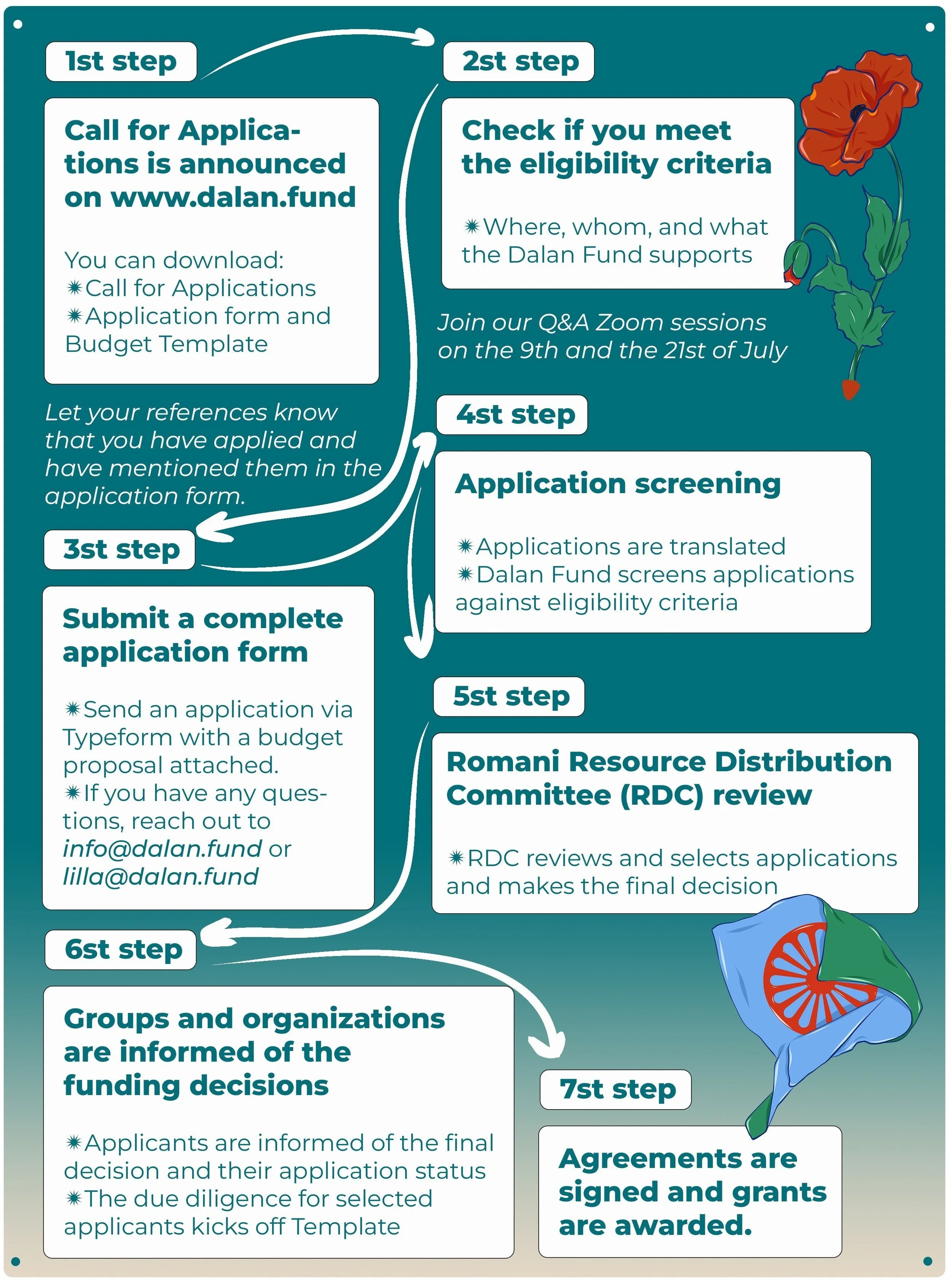
To apply, please fill out our online form in English or one of the national languages. Please note that due to limited resources and our capacity to process multiple forms of application, we accept proposals only through the online application form. All the submitted data is safely stored on Dalan Fund’s secure data storage platforms, and only relevant staff members of Dalan Fund, Romani RDC members, and our fiscal host have access to it. Before submitting, we highly suggest:
- Carefully read the application form and the attached documents to ensure that you are eligible to apply.
- Submit the proposal via Typeform (our online application submission system) by July 31st, 2025;
- If you would like to prepare the application offline, you can access the whole narrative and budget proposal forms here. However, you must submit your final application through the online system, so if you decide to work in an offline form first, you can copy-paste your answers to the online form.
➣ Hungarian: A Roma Program pályázati felhívása mostantól elérhető
➣ Polish: Trwa nabór wniosków w Programie Romskim na działania
➣ Romanian: Apelul de cereri de finanțare în Programul pentru romi este deschis acum
➣ Romanes: E Romane Programesko aplikaciako akharipe
➣ Slovak: Výzva na predkladanie žiadostí v rámci Rómskeho programu je otvorená
If you have questions or comments regarding the application process, please reach out to lilla@dalan.fund
Considerations if you use AI for writing the application
We understand that neither English nor the national languages might be your mother tongue. We also keep in mind that there are different forms of literacy, and that this type of communication might not be the most convenient for you. In addition, such applications come with certain NGOized language that might not reflect how you think and talk about your work. Having all that in mind, we understand that some people use AI to help them write applications. While proficiency in writing applications will not be a criterion, we are aware that some people would prefer to use AI. If you opt for that approach, please take into consideration the following:
- Once you enter any information about yourself and your organisation into the AI system, it stays there, and you will have no control over how it will be further used, where it will be stored, or who will have access to it.
- Do not mention names of people or organizations, location, or any sensitive information, so that your collective cannot be identified, if this information comes into the wrong hands.
- Bear in mind that AI tends to write generic responses, which might not reflect your voice, scope, and nuance of information you would like to share with us, to better understand your work and needs. Please add as much of your narrative. Otherwise, all applications written with AI support will look the same, and our Committee will not be able to make an informed decision on whom to support.
Application Form Overview and Further Suggestions
The application form consists of seven sections outlined below:
- Eligibility check.
- Contact Information of two members of the applicant organization/group, and social media links. Please make sure you provide contact information; we will use it in communications throughout the selection and grant cycle processes.
- Organizational Information that outlines questions related to the registration status, geographic scope, leadership composition, and operational budget.
- Organizational Goals, Strategies, and Tactics that explore the organization/group´s mission, focus areas, approaches, and communities served.
- Reference information from organizations you have worked with and that know you well. Please inform your references about mentioning them in the application before you apply, so that they are informed about the due diligence process if your application is selected for funding.
- A budget proposal outlining your plans to use the grant. While this grant is flexible, meaning you can change your priorities later, we need to understand your general needs and how you plan to use these resources.
- Consent for using information about your group, outlining possible purposes of usage of your information.
Please make sure you answer all the questions given in the application form. Incomplete applications will not be considered.
We strongly advise, if possible, to immediately apply to avoid any possible technology or internet failure resulting in missing the application deadline.
Timelines for Selection and Administrative Work Process
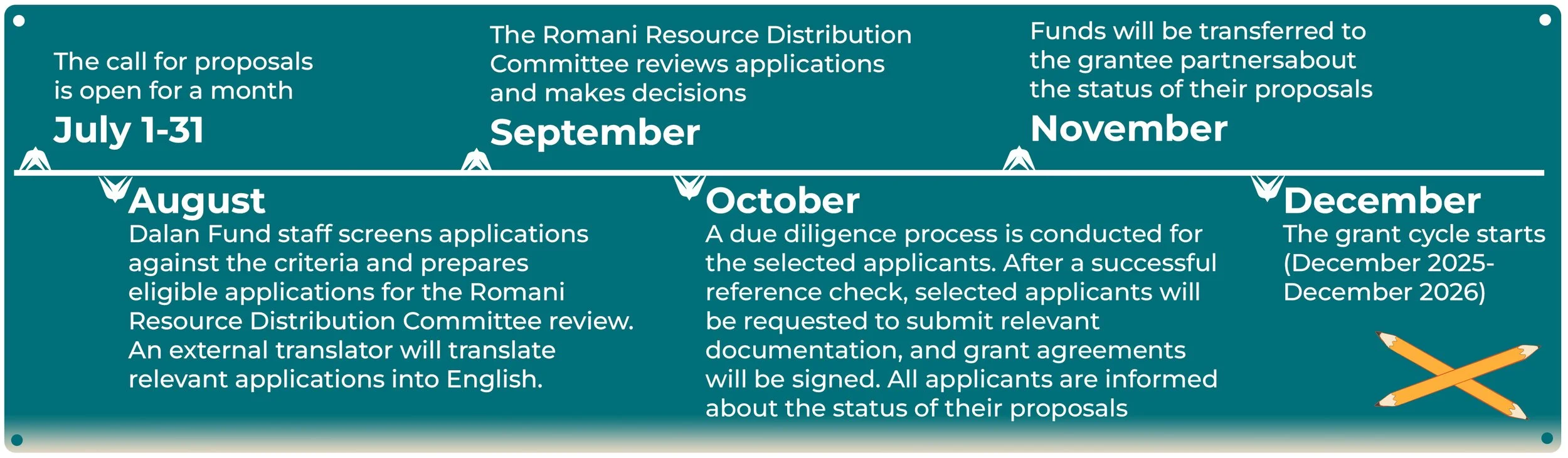
The timeline outlined here offers an overview of the process from submission of the application to selection:
| July 1-31 | The call for proposals is open for a month |
|---|---|
| August | Dalan Fund staff screens applications against the criteria and prepares eligible applications for the Romani Resource Distribution Committee review. An external translator will translate relevant applications into English. |
| September | The Romani Resource Distribution Committee reviews applications and makes decisions. |
| October | A due diligence process is conducted for the selected applicants. After a successful reference check, selected applicants will be requested to submit relevant documentation, and grant agreements will be signed. All applicants are informed about the status of their proposals. |
| November | Funds will be transferred to the grantee partners. |
| December | The grant cycle starts (December 2025- December 2026). |
Reporting Requirements and Timelines
Selected grantee partners will need to sign a Grant Agreement with the submitted application and estimated financial proposal as annexes. As part of the reporting, grantee partners will be requested to attend learning & exchange calls, and send the final narrative and financial report.
Learning calls
Grantee partners will be expected to participate in learning calls organized throughout the grant period. These virtual meetings serve as opportunities to get to know each other, share progress updates, reflect on challenges and lessons learned, and foster peer-to-peer learning across the partner network. Participation in these calls is an important part of our collaborative approach, and insights shared may inform future programming and collective advocacy efforts.
Narrative and Financial Report
A month after the grant ends, the Final Report, including the narrative and financial part, is due.
The narrative part will be discussed with the movement parties in advance.
Please note that even though DF´s grants are core and flexible, due to our donor requirements, our grantee partners will be requested to provide a digital copy of receipts and invoices, and to store invoices, books of account, and records relating to the grant for six (6) years from the date on which the Agreement terminates. The financial report with all supporting financial documentation needs to be submitted one month after the grant ends.
Contacts and Communications
Throughout July 2025, the Dalan Fund team will provide a few virtual spaces in English, with translation to national languages for direct interaction with potential grantee partners to answer all pending questions. To stay in tune with the unfolding information, make sure you:
❖ Follow Dalan Fund on Instagram and sign up for Dalan Fund´s newsletter to get updates about the Romani Program, as well as other opportunities and resources provided and curated by DF.
❖ Join our virtual Zoom Q&A sessions and ask us any pending questions you may have. The sessions will be in English, but translation into national languages will be provided if requested.
➣ Register here for Zoom Q&A on July 9, 2025
➣ Register here for Zoom Q&A on July 21, 2025
❖ Furthermore, if you have any particular questions concerning the application process that are not being addressed through these channels, please do not hesitate to reach out to lilla@dalan.fund