At the heart of Dalan Fund’s mission to transform how movements and most under-resourced communities are funded sits a program dedicated to Romani organizing in Central Europe. Grounded in the lived experiences of Romani women, this initiative aims to shift power and recognition toward Romani women and gender-diverse people, ensuring that their knowledge, leadership, and political visions inform and shape social transformation across the region. Central to this work is challenging and reshaping dominant narratives, including visual ones.
Collaboration with various visual artists and storytellers helps us shift these narratives by translating the complexity of how Roma people are perceived into powerful visual stories of transformation and liberation. In this endeavor, we have teamed up with visual storytellers and creatives, whose unique approach transforms art into a tool for advocacy and social change.

In this profile, we spotlight Sandra Carmona Durán, an illustrator and creative, specialized in social and editorial design, whose work draws on her Romani heritage and lived experience, and who created the visual identity for our Romani program.
Shifting the Narrative Through Romani Imaginaries
In her works, Sandra challenges dominant narratives about Romani people that are typically rooted in trauma and pain. While rethinking the past and present, Sandra creates visuals that highlight empowerment, pride, and diversity, calling Romani imagination and power into being.

“We don’t have to hide this [traumatic] history, but we also need positive narratives. We have to give our people and children the possibility to imagine another future and history,” says Sandra.
In her roles as both a teacher and illustrator, Sandra merges visual tools and writing fiction as a means of tapping into and expanding the political imagination of and about Roma communities. Drawing on her own childhood experiences, she wrote and illustrated a children’s book about a young Romani girl named Alma.
Through Alma’s journey, Sandra traced the process of coming to understand one’s Romani identity in a society that marginalizes and misrepresents it.
The story follows a young girl as she confronts racism, navigates belonging, and begins to claim her heritage with pride.
The book is an offering to young readers, both affirmation and the courage to imagine themselves otherwise.
Navigating the Inbetweens and Intersectional Identity
Sandra, born to a Romani father and an Andalusian mother, grew up struggling with her identity as someone of mixed Romani and non-Romani heritage.
‘I grew up thinking I had something bad inside of me. I never said I was Roma. My father always told me, “Don’t tell anyone, because you will face racism. I don’t want you to have the life I’ve had,” Sandra recalls.
Reflecting on her childhood, she recalls the persistent ache of invisibility. Beyond the boundaries of the Romani community, she was seldom acknowledged as her Romani father’s daughter, as though a part of her identity had been erased in plain sight.
For Sandra, this denial was a wound that marked and formed her early years. Yet within her home, her mother challenged this silence and prejudice, as she spoke openly and unapologetically about her marriage to a Roma man and about her daughter’s Romani heritage. She met the diminishing comments about the Romani community with moral clarity, both publicly and at home.
Although her parents separated when she was nine, Sandra’s mother ensured that the bond between father and daughter was preserved.
“It’s always difficult growing up in a divorced family, you’re caught in the middle,” Sandra reflects. “And being Roma, you’re very different; you’re in the middle in that sense too¨, Sandra says.
Existing and inhabiting the in-betweens of cultures and communities, her adolescence introduced an even greater complexity to her identity as she had to navigate both racism and homophobia.
“I had more problems saying I’m Roma than saying I’m lesbian,” she recalls.
Returning to Art: Personal History and Political Practice
The love for drawing inherited from her father’s side helped Sandra to overcome the difficult moments of her teenage life.
“I’ve studied illustration because art has saved my life. I couldn’t live without drawing when I was a child. I had a lot of anger, and I drew it out,” remembers Sandra.
Before diving into the world of visuals and studying illustration later in life, Sandra studied primary education to become a teacher, encouraged by her father. “My father told me, ‘Be a teacher, so you can teach me what I want to learn.’ I always kept that in my mind,” says Sandra.
Teaching and drawing eventually converged in her practice. Her Romani childhood became the source of her visual language. After studying illustration, Sandra began exploring how to work with her own narrative and how to represent the realities of Romani communities in ways that open up new narratives for the Roma, leading her to a deeper engagement with Romani history and her family’s past.
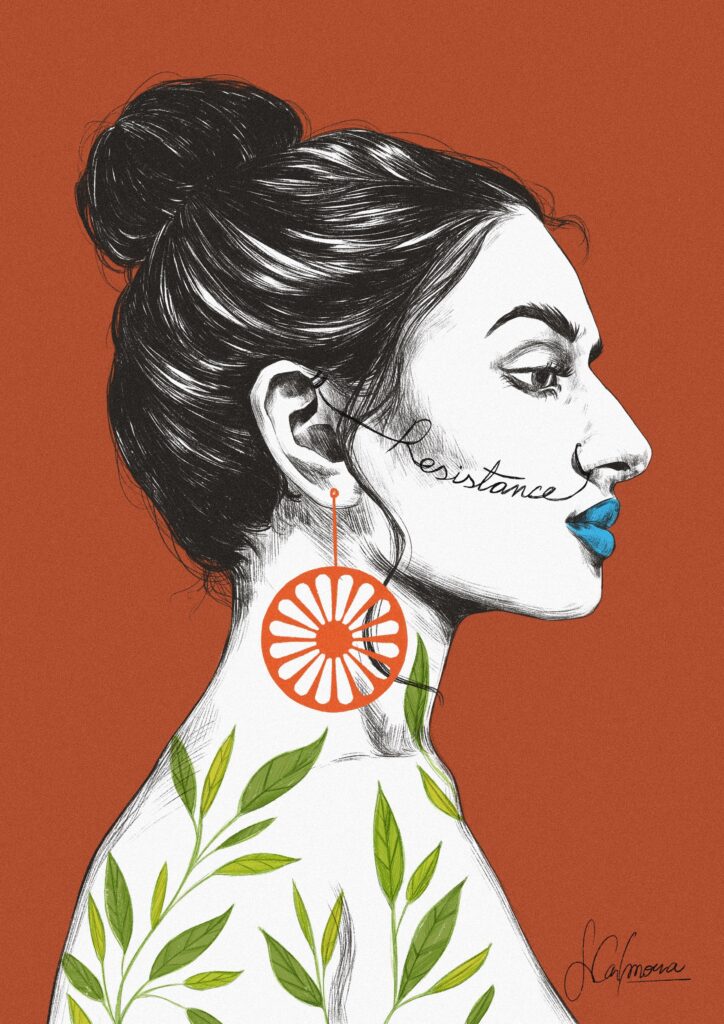
Alongside this, she developed a distinctive visual approach and iconography for representing Romani feminist imagery that is both recognizable and rooted in community experience.
At the core of her work lies a firm belief in the power of narrative: that the stories we tell, and the images we create, can shift public perception and, in time, reshape the conditions of belonging itself.

Building Visual Identity for the Romani Program at Dalan Fund
As we began developing the Romani Program, we met with our Romani Resource Distribution Committee to discuss the visual aspects of the program, particularly in relation to our narrative change goals. The advisors reflected on systemic anti-roma racism and how that shows in visual representation and spoken word, and the stereotypes that it reinforces. The Committee identified that visuals should represent dignity, groundedness, and contemporary relevance, combining modern and traditional visual elements and reflecting diversity across age, skin tone, and gender expression.
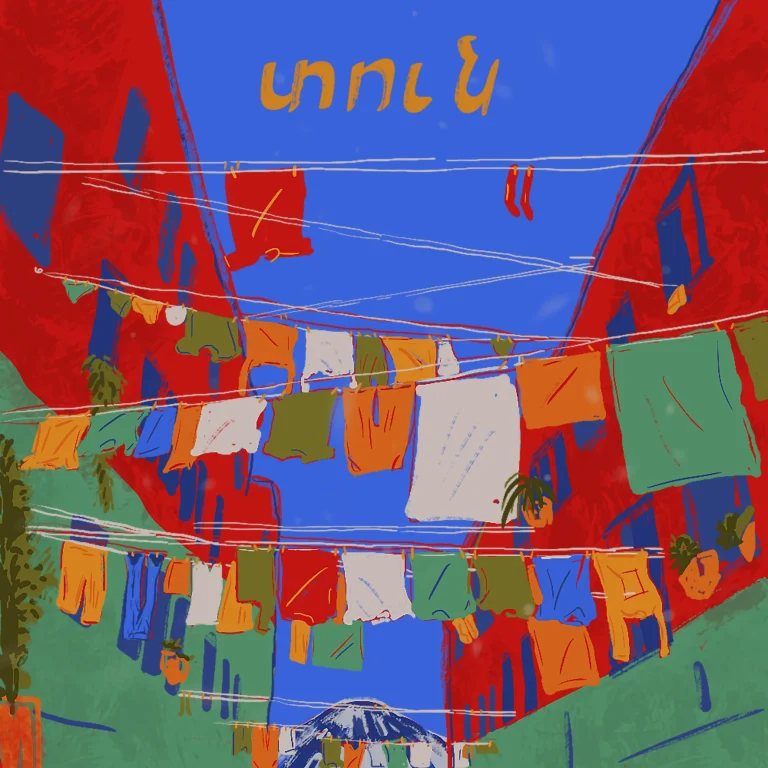
Sandra’s visual identity for the Romani Program is rooted in everyday Romani life. The colour palette draws from elements commonly found in Romani clothing, home interiors, jewellery, and crafts: colours that carry familiarity, memory, and cultural continuity. These warm pastel tones remain bright and clear, yet convey tenderness and balance vibrancy with care.
Conceptually, Sandra decided to move away from the dominant visual narratives that often frame Roma communities through struggle, racism, trauma, and persecution. To enable the imagination and Romani visions, she instead used a cultural element that embodies resilience and continuity. Her inspiration, in particular, drew from a key commonality for the Romani community, the music.
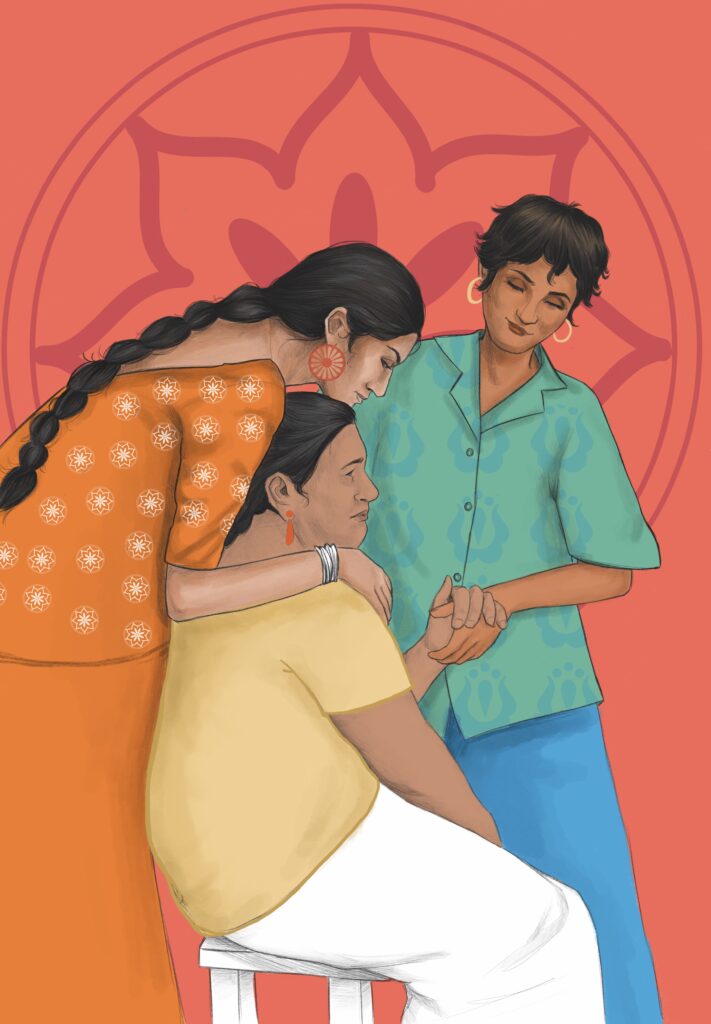

For Sandra, music represents strength, community, family, joy, history, and the living thread that connects past, present, and future. By merging elements from music, dance, and jewelry, she created icons that represent the joy and energy of Romani communities.
Music continues to guide the identity system. Inspired by the flamenco rhythm “Alegrías,” flowing lines evoke musical waves, while red dots mark the tempo, visually translating sound into movement and pulse. This subtle integration of rhythm reinforces the emotional core of the Romani Program: vitality, celebration, and collective memory.

Another image Sandra created references Indian roots and the historical symbol of the wheel, yet deliberately departs from its conventional representation. By reinterpreting rather than repeating familiar imagery, Sandra created space for renewed meaning within the Romani Program’s visual identity. Through her work for the Romani Program, Sandra crafted a visual identity grounded in lived experience, one that replaces narratives of pain with images of movement, strength, connection, and joy. It calls on the Romani community and builds on the intergenerational wisdom, solidarity, and care within the Romani organizing.
Over the course of the years, we will gradually unfold the depth and visions of Romani intersectional feminist movements, and Sandra’s work is a firm grounding in the work that lies ahead of us.