By Lilla Eredics, Coordinator of Romani Program
For in a very real sense, there is much to learn from Romani women about sustaining livelihoods, care, and solidarity beyond dominant systems. With this piece, I hope to carve out space for their knowledge and truths.
Throughout my childhood, during holiday visits to my relatives, I often listened to my mother and her female relatives telling stories about “old times” with nostalgia. Their stories unfolded tangled and blurred fragments from the 1960s-80s, showing the life and transformation of a Hungarian village’s Romani community, their roles, relationships, and the work they carried out throughout their lives.
When talking about the “old times”, their tone evoked a sense of “peaceful coexistence” between local Roma and Hungarians, a time when “Romani people had a respected way of living” in the village. Of course, time has softened memories of hardship. Romani communities have been consistently pushed to the margins through state policies, local governance practices, and broader societal attitudes that perpetuate economic, spatial, and symbolic exclusion. But within those margins, people built strong bonds of mutual aid, collective survival, and autonomous economic strategies that sustained life.
In the 1960s, local Romani men worked in their own forges, blacksmithing nails and producing goods for use and sale. Women synchronized their daily labor with the seasonal rhythms of the surrounding landscape – spinning yarn, gathering moss, tending animals, and working in the gardens and fields of Hungarian families and agricultural cooperatives. They also collected the fruits and materials of the nearby forests, which they sold at markets near the capital. These collective activities provided crucial sources of livelihood and helped sustain the community’s solidarity ties.
In today’s reality of global precarity, the erosion of collective spaces, and the narrowing horizons for secure livelihoods and resources, Romani women’s labor from care work, informal labor, to community-based forms of subsistence, remains unrecognized or devalued. In an era of global crises, it becomes increasingly urgent to listen to these stories and experiences, not simply as relics of the past, but as forms of knowledge that reveal how people sustain life under conditions of institutional vulnerability.
The stories of Romani women remain largely absent from broader histories of survival and struggle. Their labor, knowledge, and care — often carried out in households, informal economies, and community life have been invisible. Mainstream narratives rarely acknowledge them, instead framing Roma experiences as deficit, deviance, or cultural lack. Growing up, I witnessed this persistent devaluation, the othering of Romani ways of living as uncivilized or backward. These silences, and the anger that still provokes in me, have shaped my commitment to feminist and intersectional ways of resourcing and organizing.
Creative, resilient, and locally embedded practices of resourcing life
The livelihood strategies I heard about in my mother’s family were not unique. Across Central and Eastern Europe, Romani communities have long sustained life through unstable, occasional, or seasonal wage labor combined with other means[i]: small-scale farming, informal trade, exchange, and care networks. While these took different forms depending on local conditions, they emerged from the same conditions of economic dispossession and political marginalization, revealing patterned ways of making life possible where state policies, local governance, racialized labor markets, and other dominant social arenas withheld security for Romani people.
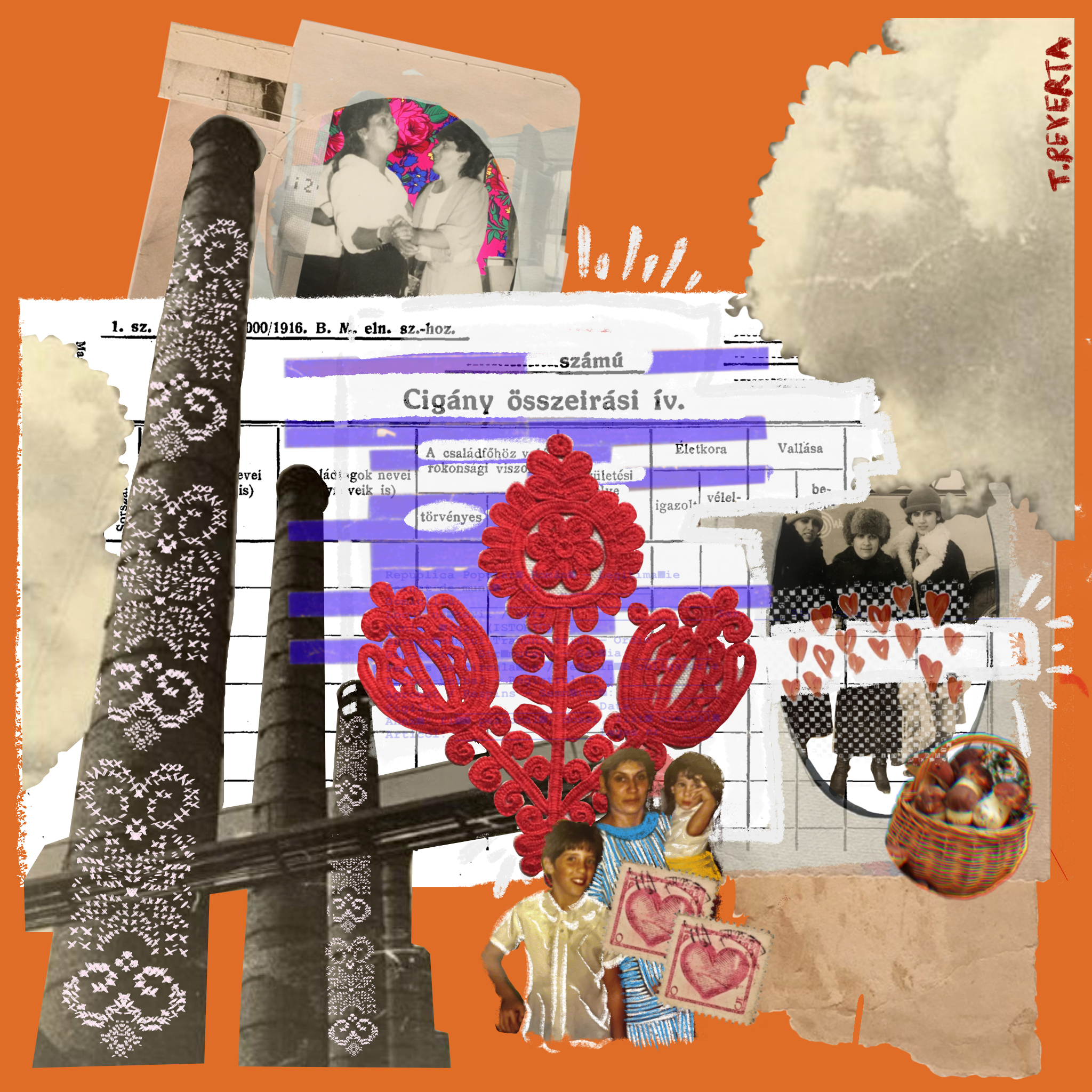
The collage by Trinidad Reyertahighlights community resources in contrast to coercive ‘assimilation,’ dismantling community means. On the photos you see my mother with me and my sister, and my mother with her own sisters.
In agricultural areas, households relied for decades on seasonal work on Hungarian peasants’ land, while women supplemented income by foraging mushrooms, berries, and herbs. Elsewhere, families raised animals for food and exchange. Men often pursued mobile trades – horse dealing, blacksmithing, tinkering – while women engaged in spinning, textile work, and other home-based activities compatible with childcare and communal responsibilities. On urban peripheries across Hungary, Romania, and beyond, families pieced together livelihoods from scrap-metal collection, street vending, petty trade, and other informal economies that offered limited autonomy amid pervasive precarity[iii].
These practices are not simply about ‘making ends meet’.[iv]They actively reproduce communities, distribute care, and generate interdependence outside the dominant structures of wage labor, state provision, and market logic. They draw on knowledge rooted in local ecologies and economies, together with kinship and neighborhood ties that can be mobilized in times of crisis.
What my mother’s family recalled was therefore not an isolated story of one village, but part of a broader pattern across Romani communities who have sustained themselves through autonomous and locally embedded forms of livelihood-making.
From local practices to wider histories of dispossession
Throughout history and across generations, these communities have repeatedly been dispossessed of the very bases of their livelihoods. The enclosure of forests, the decline in value of goods once gathered or traded, and the erosion of craft-based skills systematically undermined community-rooted ways of sustaining life. In Hungary under state socialism, such practices were further delegitimized and replaced with coerced wage labor in factories and cooperatives under the flag of “assimilation” politics. After the regime transition, community-based means of livelihood were further undermined.
Growing up, I witnessed my mother and her family’s struggles on the labour market – from periods of full-time motherhood to informal (black) employment; from participation in Roma-focused social policy programmes to unemployment; to public work; from care work in public institutions to unemployment again. More broadly, this is part of a continuing process that narrows the ways people can sustain themselves, forcing dependence on state- and market-centered forms of work[v].
The erosion of Romani women’s practices of resourcing life is not just a local or cultural story, but part of a larger structural history in which autonomous forms of livelihood and care are dismantled and devalued. Similar dynamics have unfolded globally:[vi] Indigenous communities in the Americas are dispossessed of land, peasants across Africa and Asia are pressed into wage dependency, and in Central and Eastern Europe marginalised communities are stripped of collective resources through privatisation, land reforms, and welfare retrenchment – processes that disproportionately impact women and racialised groups reliant on communal forms of social reproduction.
Contemporary stakes: reclaiming and resourcing otherwise
Carrying my mother’s memories into my work today is a way of refusing the erasure of her knowledge, and of insisting that these pieces of knowledge are not only Romani history. They are living resources for reclaiming solidarity, redistribution, and justice in the present.
They remind us that communities have always organized life, sustained one another, and reproduced social worlds under conditions of systematic exclusion, dispossession, and devaluation. What is striking is not only the persistence of these practices, but also how consistently they have been denied recognition by dominant social institutions.
Philanthropy is no exception. The chronic underfunding of Romani organizing is not evidence of weakness or lack of value – it is the direct outcome of racial hierarchies and power systems in which Roma are cast as the “undeserving poor” and as security problems within majority societies.
This takes shape in funding structures that allow small Romani groups to diminish for lack of resources, while many times, well-established non-Romani organizations have access to meaningful resources. In the broader ecosystem of human rights philanthropy, Roma rights remain among the most neglected. Of the already scarce funding that reaches the CEECCNA – only 3% of global human rights philanthropy – Roma rights stand out for their marginalization, although the 10 to 13 million Roma living in the region continue to face some of the most deeply rooted and racialized forms of exclusion today[vii ].
The silences, exclusions, and forms of devaluation I witnessed growing up drive me toward building structures that recognize marginalized communities as central political actors in social transformations. This path has led me to Dalan Fund’s Romani Program, which supports intersectional Romani organizing in Romania, Slovakia, Hungary, and Poland.
And if this work is to matter, a Romani Program inside a non-Roma fund cannot simply reproduce the same dynamics of exclusion. Rooted in Dalan Fund’s commitment to participatory, activist-led, and decolonial practices, the Romani Program centers the lived experiences of Romani women, as well as trans, intersex, and gender-diverse people. Its purpose is to foster resilience, collective power, dignity, and access to rights. In May 2025, we convened a gathering in Belgrade with the five Romani activist women of the Romani Resource Distribution Committee, initiated to ensure that the program’s foundations were built on their shared political analysis grounded in lived experiences.
The program provides core and flexible support for feminist, intersectional, community-rooted organizing, with resources directed specifically to initiatives led by Romani women and gender-diverse people. Its trajectory is shaped by our Romani movement partners, whose struggles and visions we accompany with advocacy and narrative strategies that amplify their political voices.
In a broader sense, the program aims to shift power and recognition toward Romani women and gender-diverse people, ensuring that their knowledge, leadership, and political visions shape social transformation in the region rather than remaining at its margins. With the first grantees of the Romani Program just selected, their forthcoming work will illuminate the relevance, depth, and creativity of intersectional Romani organizing across the region. The most meaningful way to demonstrate this is by lifting up their leadership and initiatives.
And in this work, I try to hold onto the fact that these shifts begin in the everyday forms of knowledge and political agency that Romani women have carried all along.